
Agencies don't need a professional test shoot before they meet you. They need something plainer: a current, unedited look at your face, your body and your proportions, shot in flat light with no styling to hide behind. That's a digital polaroid. The good news is that a decent set is entirely achievable at home with a phone, a bare wall and a window. The less good news: small mistakes — a filter, a tilted phone, a flash at midnight — can make a booker scroll past a face they would otherwise call in.
What a digital polaroid is actually for
Bookers look at polaroids to answer a few specific questions. What does this person look like right now, without makeup and styling? How do they carry themselves? What are their proportions — head to body, leg length, posture? Is the hair long enough, are the brows and skin as described, is the height plausible?
An editorial photograph can be beautiful and answer none of that, because the lighting, the styling and the retouching are doing the talking. So when an agency asks for digitals, they aren't asking for your best photo. They're asking for your clearest one.
Set the scene
Find the plainest wall in your home — white, pale grey or soft beige, with nothing hanging on it and no doorframe cutting through the background. You need roughly three to four metres between you and the phone to fit a full-length frame, so clear the floor and check what's behind the camera as well as behind you.
Dress simply: a fitted tank top with leggings, or a plain T-shirt and jeans. Nothing baggy — an agency can't read a silhouette that's hidden under an oversized hoodie. Neutral colours work best. Skip heavy makeup, chunky jewellery and busy prints. For full-length shots, stand barefoot or in flat shoes rather than heels, so your natural proportions are what they see.
Find your light
Face a window. Light coming from the front wraps around the face evenly and shows your features without drama. Turning your back to the window is the most common mistake in home polaroids: it flattens your face into shadow and blows out the background.
The best window has soft, indirect daylight — an overcast afternoon, or a room that never gets direct sun. If bright sun is pouring in, step a little further back from the glass or stretch a white sheet across part of the window to soften the beam. Switch the ceiling lights off. Mixing warm bulbs with cool daylight gives you the orange-and-green skin tones that make a submission look amateurish.
Never use the flash, and never shoot after dark with a single lamp and the phone's LED doing the work. That's a different kind of photograph entirely, and not one an agency can read.
If you can see the shape of the window reflected in your eyes, the light is doing its job.
Phone settings that matter
Use the back camera, not the front one. It's the better lens, and it means you're not holding the phone while you shoot. Wipe the lens on your sleeve first; it's greasier than anyone expects.
Before you start, check three things in your camera app:
- Portrait mode off. Blurred backgrounds hide the wall an agency wants to see and soften your jawline.
- Beauty and smoothing filters off. Check the app's own settings menu, not only the toggle on the screen.
- Gridlines on. They keep the phone level and your body centred.
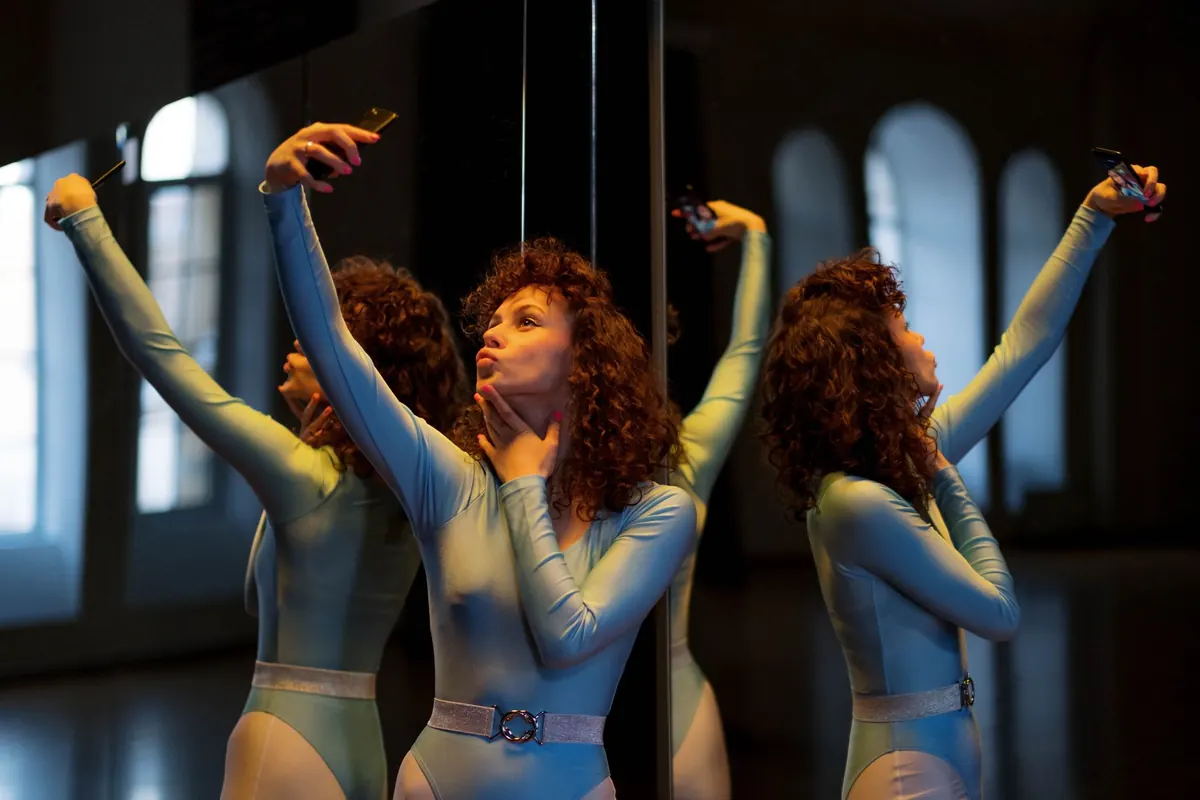
Then set the phone on something stable at roughly chest height — a stack of books, a shelf, a cheap tripod — and use the ten-second timer. A mirror selfie is not a polaroid. The phone needs to be straight, level and pointed at you from a normal eye line, never angled up from below or down from above.
Tap and hold on your face to lock focus and exposure, then drag the exposure slider down slightly if your skin looks washed out. Turn on Do Not Disturb so nothing buzzes mid-frame. If you have a second person available to press the shutter, even better — but a timer and a steady surface are enough.
The shots to take
Read the agency's own submission page first, because requirements differ. Some ask for eight images in a set order, some want a short walking video, some only need four. If there's no list, this is the standard set:
- Headshot, hair down, mouth relaxed, looking straight into the lens
- Headshot with hair tied back
- Profile, one or both sides
- Waist-up or three-quarter length, front
- Full length, front, arms relaxed at your sides
- Full length, side profile — the frame that shows posture and proportion
- Full length, back, for hair length and body line
Keep your expression neutral in most of them. Not stern, not beaming — relaxed, chin level, head straight. Shoot ten or twelve frames per pose and pick one where your shoulders are down and your weight is even across both feet.
If an agency asks for swimwear or lingerie digitals, that's your decision, and you're entitled to send a normal set instead and say so in one line. A professional agency can judge a look from standard polaroids.
Small things that ruin good polaroids
- Filters, smoothing or a vintage preset — an immediate no
- Cropping your feet out of a full-length shot
- Mirror selfies, bathroom shots, tilted horizons
- Forty near-identical photos instead of eight clean ones
- Heavy contouring, false lashes, hair covering the face
- Logos, busy prints, sunglasses, hats
- Retouching. They'll see you in person and the difference reads badly
Naming and sending the files
Export as JPEG and name each file clearly: Firstname_Lastname_headshot.jpg, Firstname_Lastname_fullbody_side.jpg. Keep each image to a sensible size — a couple of megabytes is plenty. Don't send RAW files or HEIC images that an office laptop may not open.
Put the whole set in one folder and share it with a Drive or Dropbox link, or attach the files if the agency accepts attachments. Keep the email short: your name, location, height, measurements or sizes as requested, hair and eye colour, and one line about availability. Polaroids plus stats — that's the entire submission.
Final checks before you hit send
Look at the pictures on a laptop screen, not just on the phone. Can you see your feet? Is the light even across your face? Is the background empty? Are you standing the way you'd stand in a casting room?
Then send one clean email and keep the folder. Refresh the set every few months, or whenever your hair changes, so you're never sending photographs of someone you no longer are. Agencies aren't looking for perfection. They're looking for accuracy — and a plain wall with good light gives them exactly that.
Photo: Ron Lach / Pexels