
Your first runway booking comes with a call time, a rack of clothes, shoes that may or may not fit, and a strip of floor you need to own for about twenty seconds. Nobody sits you down and teaches the walk. You either arrive knowing it or you pick it up in the ten minutes before the lineup is called. The useful part is that a runway walk is a skill, not a personality trait. It comes apart into four things you can rehearse: posture, foot placement, arm swing and tempo. Get those consistent and the walk stops feeling like a performance and starts behaving like muscle memory.
Build the Posture Before You Take a Step
Stand with your back against a wall: heels, tailbone, shoulder blades and the back of your head touching it. That's the length you want to keep. Step away and hold it.
The most common beginner fault is a pushed-forward chest with an arched lower back, which reads as stiff rather than confident. Instead, stack your ribs over your pelvis and let your shoulders sit down and back without squeezing them together. Knees stay soft, never locked. Your chin stays level, parallel to the floor.
Your gaze matters more than you think. Look toward the end of the runway, just above the heads of the front row. Staring at your feet shortens your stride and pulls your shoulders forward; staring at the ceiling makes you look like you're searching for the exit.
Check this in a mirror for thirty seconds a day. You're training the position until it holds without you monitoring it.
Heel Technique and Where Your Feet Land
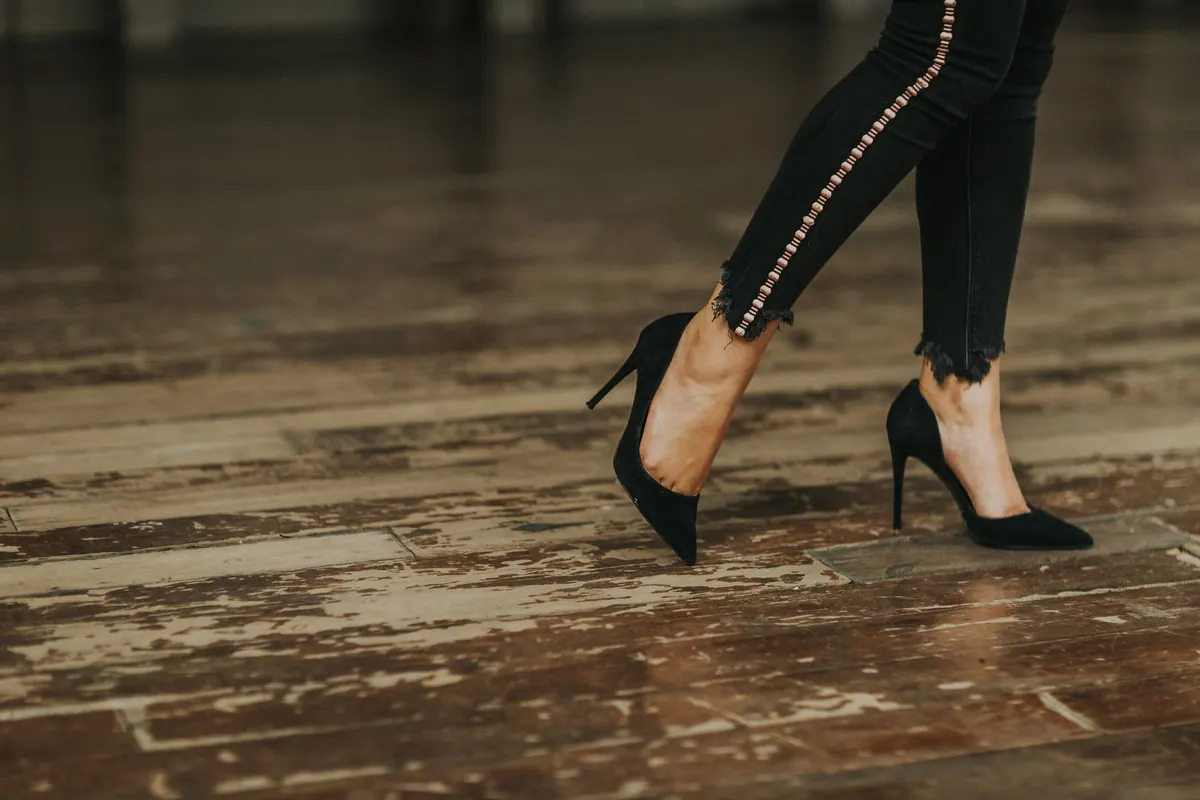
The classic description is heel first, roll through to the ball, push off with the toe. That's accurate on a block heel, a flat boot or a platform. On a thin stiletto the mechanics change: the heel is narrow and unforgiving, so you touch it down lightly, transfer weight onto the ball of the foot almost immediately, and let the ball do the pushing. Slamming a stiletto heel produces the wobble everyone wants to avoid.
What you should not do is walk permanently on the balls of your feet. That produces a hunched, tip-toe shuffle that reads as nervous from the front row.
Your feet also travel in a narrow corridor. Picture a line running from the centre of your body toward the end of the runway and place each foot on it or just beside it. Beginners often over-correct into a dramatic cross-over, which looks like swaying rather than elegance. A slight cross is fine once your ankles are strong; a full cross-over with untrained balance is a rolled ankle waiting to happen.
If you're new to heels, build up gradually rather than wearing them for hours on day one. Persistent foot or ankle pain is worth a conversation with a podiatrist or physiotherapist rather than a shrug.
Five Drills for Balance and Footwork
- Wall check. Thirty seconds against the wall, thirty seconds free-standing, twice through. Notice where you collapse.
- Line walk. Ten metres and back along a floor seam or a length of tape, heel-to-toe, counting four beats per step. Slow is the point.
- Single-leg hold. Thirty seconds on each foot, wearing the actual shoes. This is where ankle stability is built.
- Slow-motion walk. Walk at quarter speed with your phone propped against a wall. Watch your shoulders, your hands and your gaze, not your legs.
- Turn repetitions. Five turns in each direction at the end of the corridor, every time, until the pivot stops feeling like a decision.
Arm Swing That Doesn't Look Choreographed
Arms swing from the shoulder, not the elbow. Keep a slight bend in the elbow and let the hands stay relaxed, fingers softly curved, thumb resting near the index finger. The stiff claw hand is the giveaway of a nervous walk.
Keep the swing small — a few inches forward and back — and let the opposite arm move with the opposite leg, the way it does when you walk to the shop. Anything wider starts to look like marching.
Many shows override this entirely. You may be asked for hands on hips, hands in pockets, or one hand holding a strap. Follow the brief you're given. If you're carrying a bag or a folded garment, keep that arm still and let the free arm swing naturally.
Turns at the End of the Runway
Approach the mark without slowing to a stop. Plant the foot opposite the direction you intend to turn, pivot on the balls of both feet, and let your head be the last thing to come around. Holding your eyes on the camera or the front row for an extra half-second makes the turn read as intentional rather than accidental.
Editorial shows usually want a slower, softer turn. Commercial and swimwear work often wants something sharper and quicker. Practise both, in both directions, so neither one surprises you on the day.
Hold your final pose for a beat or two, depending on what the choreographer asks, then walk back at the same pace you came out. Exits get rushed far more often than entrances.
Matching the Music and Holding Your Pace
Find the pulse of the track before you step out. Runway music usually sits somewhere in the range of a steady, walkable beat, and the simplest approach is to step on the beat — one step per beat for a slower walk, two for a quicker one.
Consistency beats speed every time. If you drift behind the music, take up the slack with shorter steps and faster turnover, never by lengthening your stride; reaching turns a confident walk into a lunge. Rehearse with a metronome app or a playlist of steady-tempo tracks until you can hold a pace for a full length of the runway without counting in your head.
And resist the urge to slow down for the photographers. Walk the whole runway at one pace and let the poses happen at the end.
Before You Walk the Show
Rehearse in the actual shoes, or something with the same heel height and sole grip. Walk the space if you're allowed to, so you know where the floor changes, where the lighting hits and where your mark sits. Confirm with the choreographer whether you turn left or right, whether you pose, and how fast the lineup moves.
On the day, warm up your ankles and calves, breathe out before you step out, and keep your face relaxed but present. The walk should look like you're comfortable in the space, not like you're counting. That comfort is what casting directors remember, and it's built in a hallway, long before the lights come up.
Photo: Luis Quintero / Pexels